Four key takeaways from the UKISUG BTP Symposium
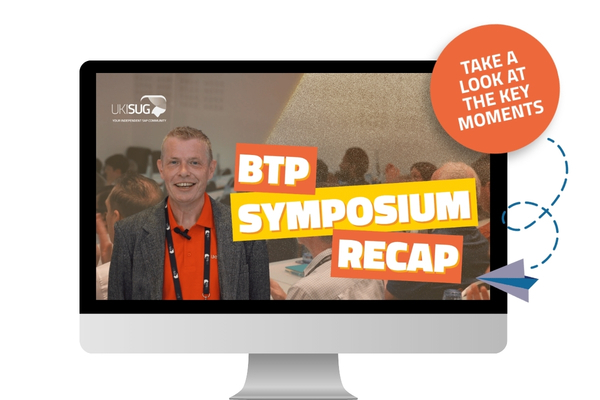
We recently hosted our latest BTP Symposium – bringing together SAP experts, customers and partners to explore how organisations can modernise, integrate and innovate across their SAP landscapes.
From the growing role of AI agents to the importance of trusted data and process knowledge, here are four of the Symposium’s key takeaways.
1. BTP is becoming the foundation of SAP’s AI strategy
SAP Business Technology Platform (BTP) is no longer being positioned simply as a platform for integration and application development. Increasingly, BTP is the foundation on which SAP’s wider vision for the autonomous enterprise will be built.
SAP is bringing BTP and Business Data Cloud (BDC) together under its new Business AI Platform positioning. This combines data, integration, application development, process intelligence and AI governance. Together, they enable organisations to build and run AI agents using trusted business data and established SAP processes.
For customers, the implication is clear: BTP should not be treated as an optional technical add-on or an isolated IT project – it’s an enterprise-wide capability that needs to be supported by the right operating model, governance, skills and investment.
2. SAP’s vision is moving from AI assistance to AI execution
The autonomous enterprise was a central theme throughout the Symposium. Here, the aim is not to replace employees, but to break down silos and enable AI assistants and agents to complete more tasks across functions such as finance, procurement, HR and customer experience.
SAP Joule will increasingly act as the primary interface through which employees identify priorities, access insights and initiate actions. Beneath this interface, specialised assistants and agents will execute individual parts of business processes, with multiple agents working together to complete more complex tasks.
Delegates saw this vision in action during a demonstration of finance agents identifying and resolving mismatched documents as part of a reconciliation process – rather than simply presenting information for an employee to investigate manually.
The broader message was that enterprise AI is evolving beyond chatbots and productivity tools. It is becoming an execution layer embedded directly within core business processes.
3. Trusted, contextualised data is essential for enterprise AI
AI is only as effective as the data it can access and understand. Several speakers warned that organisations cannot simply extract raw SAP data tables, place them in a data lake and expect an AI model to interpret them accurately.
When data is removed from SAP without its relationships, definitions, hierarchies and wider business context, organisations must recreate that meaning elsewhere. This process can increase costs, duplicate work and create additional data silos, while reducing confidence in analytics and AI-generated outputs.
Business Data Cloud is intended to address this challenge by turning SAP data into managed, semantically rich data products. These products retain the context required to understand what the data represents and how it relates to information across finance, HR, procurement and other business functions.
The Symposium also highlighted SAP’s acquisitions of Dremio and Reltio. Dremio is expected to strengthen SAP’s ability to query large volumes of data where it resides, while Reltio extends master data management capabilities across mixed SAP and non-SAP environments.
Together, these developments underlined the importance of creating a trusted and connected data foundation before attempting to scale enterprise AI.
4. Process knowledge is as important as access to data
Giving an AI agent access to an SAP API does not automatically mean it understands the business process behind a transaction.
Paying an invoice, for example, involves much more than submitting a payment. The system may need to check the relevant purchase order, confirm that goods have been received, identify possible duplicate payments and account for tax requirements, tolerances and payment terms.
An agent that does not understand these controls could fail to complete the task, bypass important safeguards or introduce financial and compliance risks.
SAP’s Knowledge Graph is designed to address such challenges by mapping the relationships between business data, entities and processes. This gives AI agents the context needed to understand not only what action has been requested, but also the correct process for completing it.
This process context was presented as a potential differentiator for SAP’s approach to AI. SAP already holds decades of industry and process knowledge, which can be used to ground agent behaviour and help organisations deploy AI safely and effectively.
Preparing for the next phase of enterprise AI
The Symposium demonstrated that the transition towards more autonomous enterprises will involve much more than adopting a new AI tool.
Organisations will need a strong technology foundation, trusted and contextualised data, clearly defined business processes and robust governance. Platforms such as BTP must be treated as a strategic enterprise capability rather than a collection of individual technical services.
Click here to find out more about UKISUG’s Platform Community.