Simplifying Enterprise Architecture: How SoftwareONE Governs 400+ Apps with LeanIX
Simplify before you scale. It’s the first step for any enterprise trying to reduce complexity and rationalise its application landscape and the one most often skipped in the rush to transform.
Because the hard part is rarely the technology. It’s knowing what you actually have, who owns it and what breaks if you change it. Most organisations know their application landscape is messier than it should be. Fewer are willing to stand up in front of their peers and talk through exactly how messy it was, what they tried first and which part they had to scrap and start again.
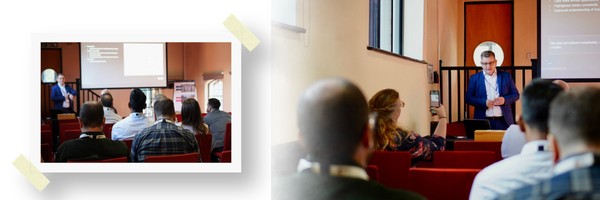
At our recent BTM Forum, Sorin Sferle, Enterprise Architect at SoftwareONE, did precisely that – sharing how his team used SAP LeanIX to turn transparency into control across more than 400 applications and how they're now connecting AI to that foundation.
The starting point was familiar: multiple countries, multiple organisations and applications shaped by local decisions made for good local reasons. Several served similar purposes, some with country-specific features the others lacked, which made it genuinely hard to decide which to keep.
"Complexity grows, but control does not."
The team already knew its applications, processes and data. What it lacked was a framework to bring them together.
Start with ownership
With more than 400 applications in scope, the first priority was simple: capture them all in a single repository and give each one an owner. Today every one of those applications is governed with assigned ownership, and the team tracks functional fit, technical fit, business criticality and business capability for each.
One of the earliest wins was also one of the least technical. LeanIX was linked to Jira Service Management, so application owners are notified whenever a ticket is raised against their application.
"It's probably not a big technical challenge, but it was a game changer when owners started to know what tickets were being raised."
A useful reminder that the highest-value change isn't always the most sophisticated one.
Simplify before you scale
Mapping business capabilities was the hardest step – and the one SoftwareONE had to do twice.
The first attempt produced a five-level model that mixed capabilities with processes. Some areas stopped at level two or three, others ran all the way to level five and the result was that nobody was sure where an application actually belonged.
The team paused and started again, this time with LeanIX's proposed two-level model. Once every application was mapped to it, they added a third level adapted to their own business. With capabilities mapped correctly, conversations with the business became significantly smoother.
"Level three is complex enough. If you get to level five, that's fine. But make sure you're not mixing up business capabilities with business processes."
That single piece of advice is the kind of thing that saves another organisation months and it's only available because someone was willing to talk openly about a false start rather than present a tidy success story.
From documentation to decisions
A model that isn't maintained becomes shelfware. To avoid that, SoftwareONE introduced lifecycle management, regular revalidation of applications and owners and stakeholder surveys within LeanIX. Static documentation became ongoing governance.
The TIME framework — Tolerate, Invest, Migrate, Eliminate — then connected each application to business criticality, technical fit and functional fit. Running the full portfolio through it surfaced genuine conflicts: one part of the business investing in an application another had written off as no longer relevant. It also prompted harder questions. Was any mission-critical application heading for elimination and if so, what would replace it?
Integration mapping exposed the hidden wiring. SoftwareONE has four customer-facing portals connected to legacy CRMs and ERPs, some retained for legislative reasons.
"We did not reduce complexity – we made it visible."
The team can now spot duplicate interfaces and see which integrations any change will touch.
Linking applications to processes added the final layer. LeanIX isn't a business process management tool and both approaches have to coexist – but the link revealed how many processes depended on ServiceNow, which is being replaced by Jira. New applications now pass a governance gate covering business justification, architectural fit and consolidation checks, integrated with procurement, contract management and renewals. The spending conversation now happens before the commitment, not after.
Where AI comes in
With the foundation in place, SoftwareONE connected LeanIX to AI through its MCP server.
Model Context Protocol is an open standard that lets AI assistants securely query live business systems rather than relying on static exports or training data. In practice, it means an architect can ask a question in plain English and get an answer drawn from the current state of the architecture model – no dashboard, no report request, no waiting.
"A game changer."
Questions that once needed a dashboard – how any applications lack an up-to-date lifecycle, for instance – are answered instantly. Diagrams that used to take time can be built simply by asking. And architects can use whichever AI assistant they prefer.
SoftwareONE is also connecting its company-wide initiatives in Jira to an enterprise architecture agent. In an organisation of 13,000 people, nobody can know about every initiative. The agent spots work that affects the landscape – an integration that isn't yet recorded or one being built against an application already marked for elimination and notifies the responsible architect.
Crucially, the agent classifies, maps and validates, but the MCP connection is read-only and humans make the updates. The next challenge is language: many people still call Business Central "NAV" and the customer portal goes by several names. Teaching the agent to translate everyday language into LeanIX terms is, Sorin admitted, "the uphill battle going forward".
Proving it in a merger
The structure proved it’s worth when two companies combined, one of around 10,000 employees and one of around 4,000. For service delivery, one used ServiceNow for customer tickets while the other combined Jira with its ERP.
Placing capabilities, processes and applications side by side allowed the team to decide – in Sorin's words – “with no particular feelings between the two companies" which approach was best. Structure replaced sentiment.
Lessons learned
- Application landscape clarity is valuable, but not sufficient on its own.
- Real impact comes when applications are connected to capabilities and processes.
- Decisions become clear when you compare process fit, not just systems.
- Structure enables faster, fact-based decisions, especially in complex environments like M&A.