06 Jul 2026

Getting Stakeholder Management Right

Tech & Business Collaboration Blog Series - Part 1

In the first of our series of blogs looking at how to improve tech and business collaboration, we look at the challenges organisations face when it comes to stakeholder management. 
 
Stakeholder management sits at the heart of every successful technology project. Yet organisations often find themselves tripped up by the same recurring challenges, from personnel changes to blurred accountability.
 
Participants in our workshop highlighted five common stakeholder-related challenges, along with practical recommendations for each.
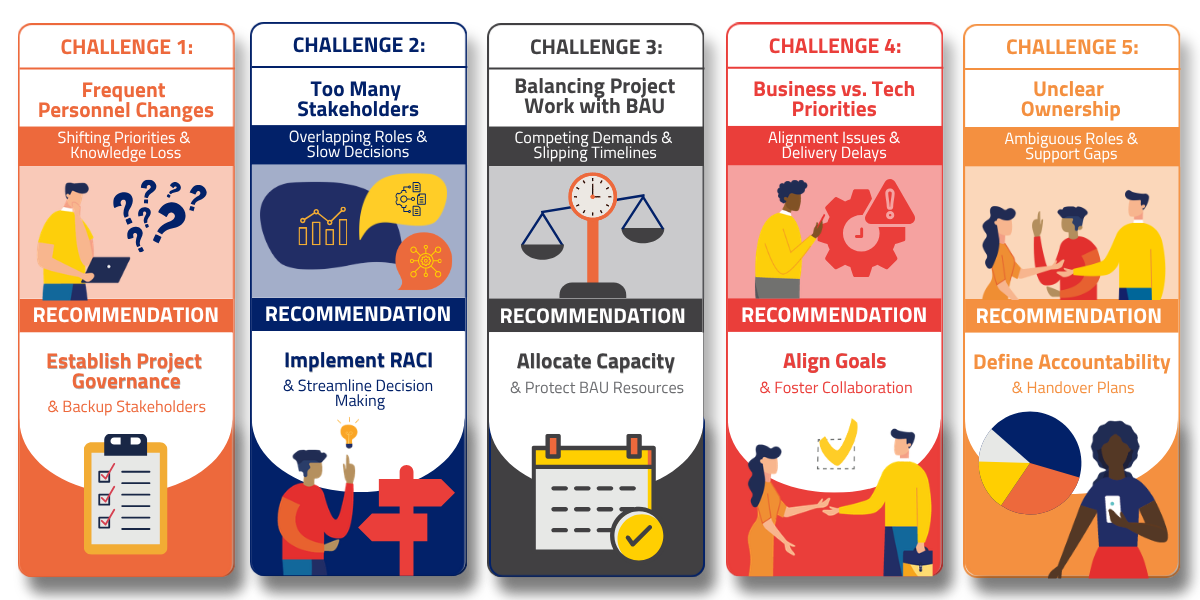
 
Getting Stakeholder Management Right - Infographic.png
 

Challenge 1: Frequent personnel changes with shifting priorities

When key stakeholders change roles or leave the organisation, transformation projects can suffer as decisions stall, strategic direction drifts and organisational knowledge walks out the door.  This can lead to priorities being constantly reset and teams struggling to meet ever-changing goals.
 
Recommendation: Establish a robust project governance framework that reduces dependency on any single individual, and where possible, assign primary and backup stakeholders for critical roles. Document decisions and their rationale in a central project log and ensure thorough handover processes are built into project plans. Most importantly, business and technology priorities must be regularly reviewed to ensure that the overall project team is aligned on strategic priorities.
 

Challenge 2: Too many stakeholders causing an overlap in responsibilities

More voices do not always lead to better decisions. When too many stakeholders share overlapping responsibilities, decision making can slow to a crawl and accountability becomes diluted. Unclear escalation paths can lead to inefficiencies and delay resolution times. In addition, scope creep becomes a near-constant threat, as competing business and technology interests pull transformation projects in different directions – this is often a result of the initial scope not being fully understood from the outset.
 
Recommendation: Right-size the stakeholder group as not every interested party needs a seat at the decision-making table. Implementing a RACI framework can help clarify roles, distinguishing between those who are consulted, those who are informed, and those who hold genuine accountability.  Before any keyboard is touched, all stakeholders should be in lockstep on a project charter: What are we doing? How are we doing it? And who is doing it?
 
By limiting operational discussions to relevant stakeholders only, organisations can establish core decision-making groups and escalation paths. This ultimately can improve the velocity and trajectory of projects, while reducing the risk of conflicting direction.
 

Challenge 3: Balancing project work with BAU

Managing both project deliverables and day-to-day operational responsibilities is a constant juggling act. This can be especially common when business users are seconded onto projects, which can result in business as usual (BAU) demands coming into conflict with project commitments. When BAU takes priority, project timelines slip. When project work takes over, operational performance suffers. The tension between the two is real and often underestimated.
 
Recommendation: Be explicit about capacity allocation from the outset to define dual ownership for project and BAU responsibilities Where possible, organisations should ring-fence dedicated project time for key contributors and work to backfill operational duties during intensive project phases. Through clear communication and the use of capacity and resource allocation tools, organisations can identify pressure points before they become crises.
 

Challenge 4:  Business and technology priorities conflict

Misalignment between business and technology teams remains one of the most persistent sources of friction. Business stakeholders often prioritise speed, commercial outcomes, and user experience, while tech teams focus on stability, security, and technical standards. Without a shared vision, the result is slower delivery and the risk of solutions that neither side fully endorses.
 
Recommendation: Alignment across the whole organisation is essential – here a top-down approach works well, meaning that projects aren’t seen solely as business or IT programmes.  Invest in early and ongoing alignment sessions that bring business and technology leads together around shared objectives. Joint ownership of the project roadmap, rather than separate business and technical workstreams, can foster greater collaboration and shared accountability. Here establishing cross-functional governance boards and a Centre of Expertise can act as the bridge between both business and tech teams.
 

Challenge 5: Unclear ownership for BAU and project delivery

If it’s not clear who owns BAU or project issues, things will fall through the gaps.  It is also common for BAU support to only be considered near go-live, meaning it often is rushed. Confusion over responsibilities creates blind spots, increases operational and project risk, and leads to a frustrating cycle of finger-pointing when problems emerge.  Furthermore, as organisations transition from on-premise solutions to the cloud, BAU structures will likely change as it will be a different target operating model post go live.
 
Recommendation:  From the outset define a single point of accountability for BAU and project delivery. Using a RACI framework, organisations should document roles, responsibilities and escalation paths to prevent ambiguity. In addition, during transition phases handover milestones should be established alongside clear communication with BAU and project delivery teams. Having such a foundation in place is essential to delivering success as BAU structures evolve over the course of a project.

Final thoughts

These challenges are not unique to any one organisation or industry and they continue to appear in technology projects of all sizes and sectors. With the right governance structures and communications practices in place, effective stakeholder management is possible.  But organisations need to see it as a strategic enabler rather than an administrative burden.
In our next blog, we will take a deeper look at the role of communication in improving business and tech team collaboration.
 

Other Parts of the Blog Series

Tech & Business Collaboration Blog Series - Part 2

Read Now

Tech & Business Collaboration Blog Series - Part 3

Read Now

Tech & Business Collaboration Blog Series - Part 4

Read Now